REFRIGERATOR:
A dilution refrigerator is a device that can achieve and maintain
temperatures near 7 mK.
It can be divided into four main sections: 4He pot, still,
heat exchangers and mixing chamber. A mixture of 4He
and 3He gas is condensed into the fridge at the 4He
pot, which is cooled to 1 K by evaporative cooling of 4He.
The liquid helium mixture is pumped at the still which further cools
the mixture to around 0.3 K, by evaporative cooling of 3He.
Below 0.8 K the mixture of 4He and 3He phase
separates into two phases: one is pure 3He and the other
is 4He with a small quantity of 3He, the so-called
dilute phase. The boundary between these two phases sits in the
mixing chamber. As the still is pumped, differences in vapor pressure
between the two isotopes leads to 3He being primarily
removed from the dilute phase in the still. It is then energetically
favorable for 3He in the pure side to move across the
phase boundary to replenish the dilute side. This movement of 3He
from the concentrated phase into the dilute phase is analogous to
evaporation and has associated with it a latent heat. The 3He
that is pumped off at the still is returned to the pure side of
the mixing chamber by liquification at the 4He pot and
is precooled through a series of heat exchangers in order to continue
the cooling process.
SAMPLE
REGION: CALORIMETER
Thermodynamic properties of superfluid 3He, such as specific
heat, are measured in this experimental sample region. Specific
heat measurement requires low and controlled heat capacity for materials
other than the substance of interest, 3He in this case.
Therefore, a superconducting cadmium heat switch is used to isolate
the sample cell from the nulcear stage for the measurements. Also,
low heat leak into 3He is crucial, and disconnecting
the sample cell from the nuclear stage enables us to reduce the
heat leak into 3He to as low as 80 pW. Once the sample
is cooled to sub-mK, a standard adiabatic heat pulse technique is
used to measure the heat capacity.
ADIABATIC
NUCLEAR DEMAGNETIZATION:
In the nuclear stage a paramagnetic material, either Hitachi copper
or praseodymium-nickel-5, is placed in an external magnetic field
of ~8 T. With the field in place the nuclear spins in the paramagnetic
material align parallel to the field. The field is then slowly (adiabatically)
lowered to zero and the system of nuclear spins disorder from the
low entropy (ordered) state into a configuration of higher entropy.
This proccess absorbs heat and cools the 3He down to
~500 µK.
NMR
SAMPLE REGION:
Using nuclear magnetic resonance (NMR) the spin state and spin dynamics
of superfluid phases of 3He are studied in this sample
region. This is, in fact, how the superfluid phases of 3He
were discovered and identified at Cornell University in 1972. This
discovery led to the Nobel Prize in Physics in 1996. Here at Northwestern
we have studied the magnetization of superfluid 3He-B
and NMR of superfluid 3He in aerogel.
|
|
| |
 |
| Cryo2 | |
 |
| Nuclear Stage |
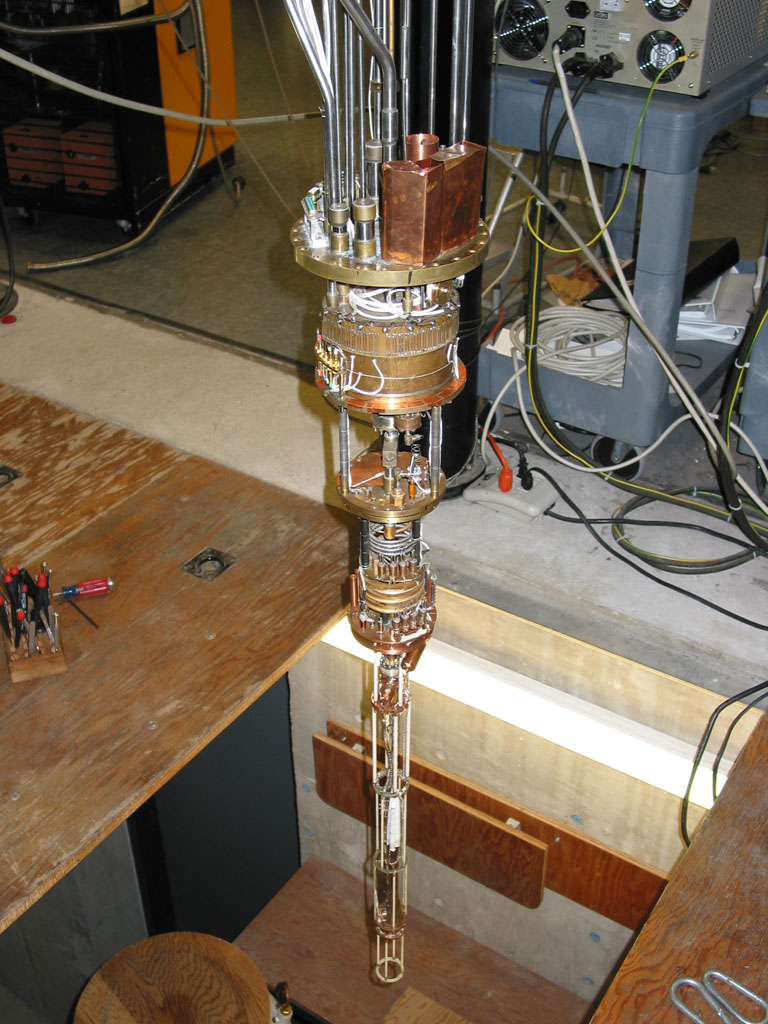
Cryo2 has a PrNi5 nuclear demagnetization stage precooled by a model DRP-42 dilution fridge from SHE. If you are wondering what this means, you have not payed attention to our web-site closely enough. We know that life is short and it may be a little too short for you to stare at our web-site all day, but since you have made the effort to come this far, please take some time and look at our web-site a little more carefully. It'll be a great opportunity to learn about ultra low temperature physics. Now, if you have already looked at our web-site inside out and are still going 'what does this mean?', you can contact Johannes Pollanen (j-pollanen@northwestern.edu) or Leo Li (Jiali2015@u.northwestern.edu) and we will be happy to discuss low temperature physics and answer any questions you might have about the work we do.
 |
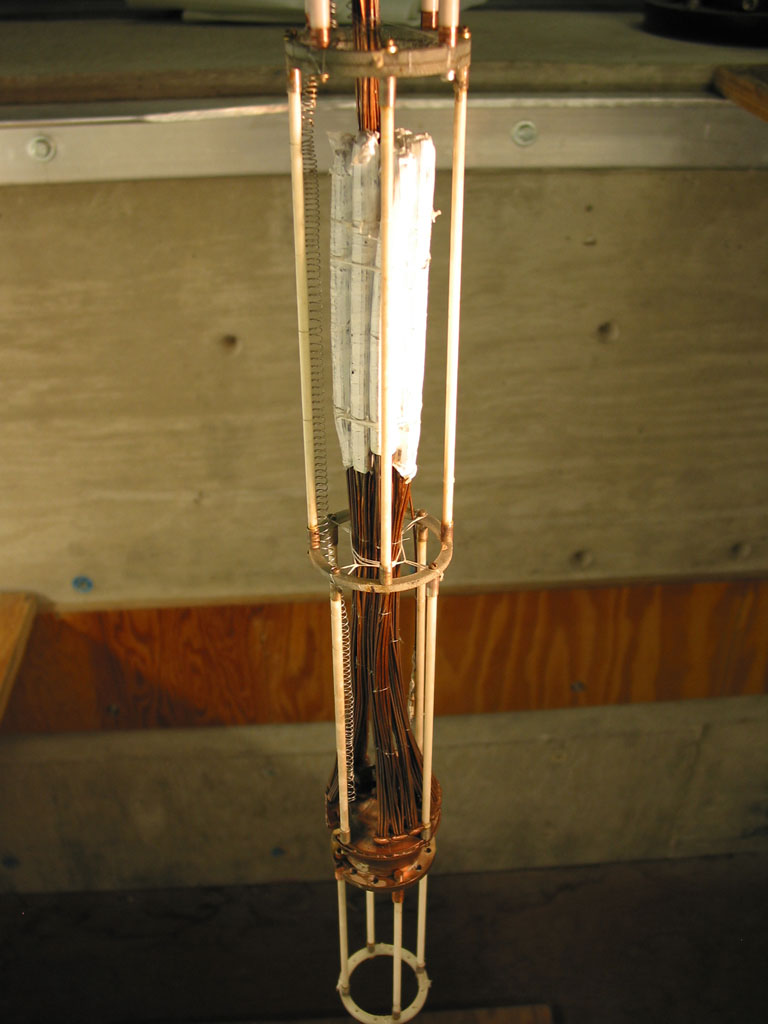
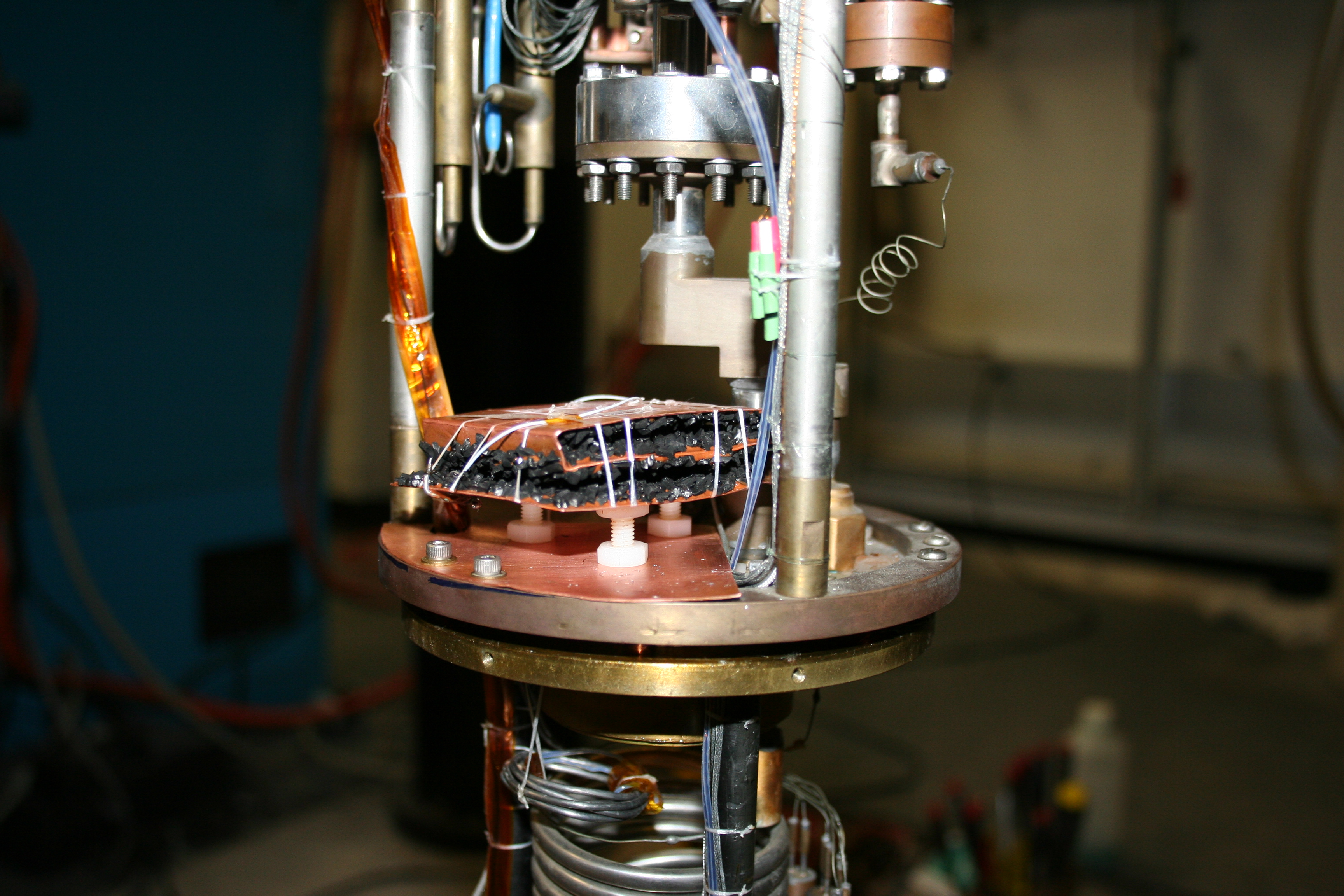
| NMR sample cell and silver heat exchanger for NMR studies on 3He in aerogel. | |
 |
|
~10g activated charcoal sorb on Cryo2 still plate. Designed to neutralize a cold leak from the mixing chamber. |
Anyway, back to Cryo2. Cryo2 is equipped with a 3.5 Tesla magnet for nuclear magnetic resonance (NMR) experiments at ULT. Specifically, Johannes and Leo are performing NMR experiments to study the properties of superfluid 3He in aerogels with different anisotropy that were grown and characterized right here in our lab. If you want to learn more about aerogel we also have a wonderful section of our site devoted to our work with high porosity silica aerogels, so check it out! Anywho, in the NMR sample cell shown in the picture, there are 3 different kinds of aerogel each having differing types of microstructural anisotropy. From bottom to top we have an isotropic aerogel, an axially compressed aerogel and an intrinsically shrunken aerogel. There are theoretical predictions that different types of anisotropy in aerogel will stabilize different superfluid phases or different order parameter structures of 3He (i.e. textures of the order parameter). Data taking an analysis are currently underway and the results are looking very interesting indeed! Stay tuned to this page and our publication list to find out about all the cool stuff we learn in the next little while about 3He in aerogel.
As of February, 2011, Johannes and Leo are finishing up the measurement and analysis on the radially shrunken aerogel. Leo is currently working on the new NMR sample cell for studying time reversal symmetry breaking in 3He superfluid A phase.
|
|
|
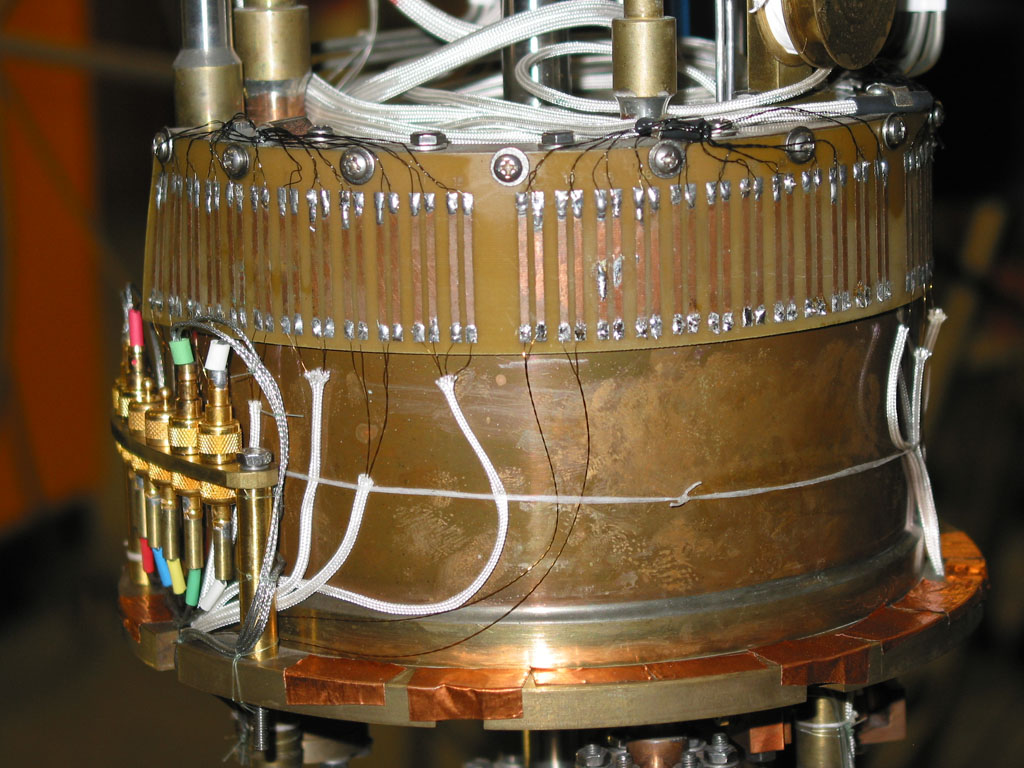
4He 1K Pot |
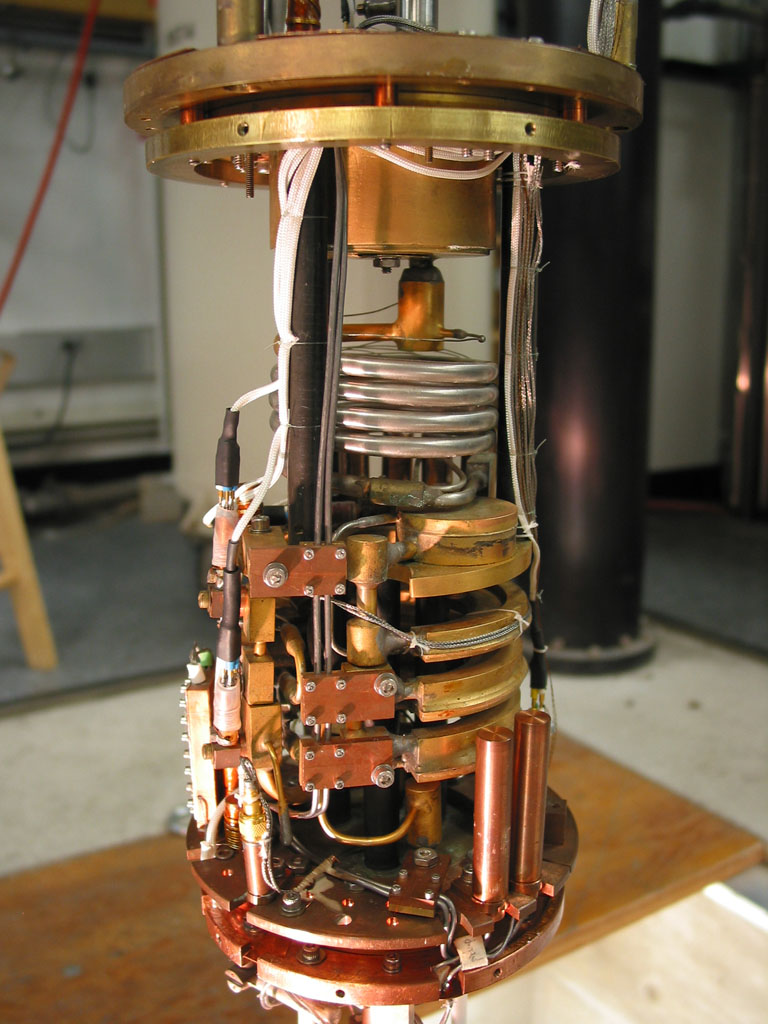
Dilution Fridge |
|
Home
| Aerogel | 3He Calculator
| People | Facilities
| Publications | Links |
|
|
|